Rising misinformation under lockdown in India: A Research
As the country fights Covid-19, with cases reaching towards 2,00,000 fake news also seems to be spreading along with the virus. An analysis by fact-checking website BOOM has found that while January-February saw most rumours about China and false forecasts about coronavirus vaccine, fake news on Italy lockdown went viral in March. And in April, publicly charged misinformation targeting the Muslim community became more common.
The study has been conducted through data and evidence of viral data, such as trending news topics and types of media through which this information was spread. Matters like prediction theory, bio weapon, economy, health, politics, Italy, China, cure/prevention/treatment, lockdown and communal were trending in between the months of January to April.
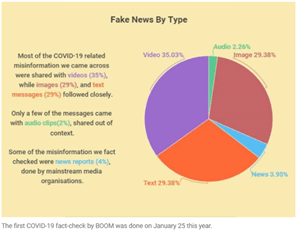
India is entering a phase in which people are intended to be affective around identity and emotion rather than instrumental proofs that can be scientifically verified, the study said. Therefore, from presenting fake cures or fake images of pain, which, over time, get deflated or appear suspicious to viewers–the fake news has moved to cultural elements that are harder to verify.
A study on fake news in India by scholars from the University of Michigan which was released on April 18, 2020, has shown a rise in the number of deflated stories, particularly after the declaration of Janata curfew by Prime Minister Narendra Modi on March 22, 2020, and the nationwide lockdown two days later, to contain the spread of COVID-19.
The motion of misinformation was already building up before PM Modi’s declaration of the Janata curfew, but there was a steady rise in the number of debunked fake news, following the third week of March 2020.
Two categories of fake news that caught the eye of the investigators due to their consistent rise were stories around culture and government. This pattern appeared with a visible increase in stories around Muslims and COVID-19 as well as stories around police brutality. By the end of March 2020, the number of fake stories increased, with the Tablighi Jamaat event at Nizamuddin Markaz in Delhi being highlighted as a vector of novel coronavirus, according to media reports.
Post the Tablighi Jamaat incident, we saw a change in the tone of fake news which was seen focussing on a specific community that was being targeted as the ‘super spreader’. When it comes to public posts, only text does not create the sort of required emotional link with the viewer and people cannot really figure out whether a video clip is new or old.
Facebook is by far the worst culprit when it comes to distribution of fake news. It is worse than Google, worse than Twitter and worse than webmail providers such as AOL, Yahoo!, and Gmail. This pattern of differential Facebook visits immediately prior to untrustworthy website visits is not experiential for Google (3.3% untrustworthy news versus 6.2% hard news) or Twitter (1% untrustworthy versus 1.5% hard news).”
The graph below represents the size of the effect.
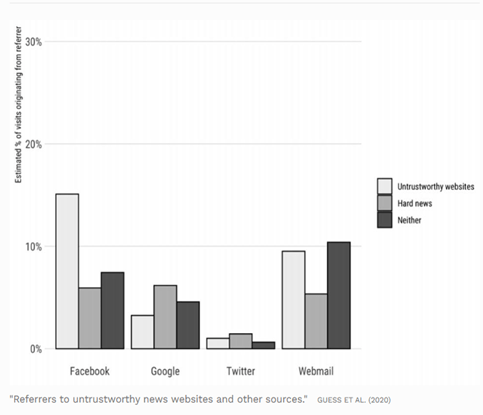
What is clear, however, is that Facebook was a “key vector of distribution for unreliable websites.” This epidemic has led to an overload of misinformation, which is why it very important to think critically during these times. Reposting without verifying will only add fuel to the fire, while exactness can help in curing and calming down the pandemic suspicion.
By Anjani Sharma
 Street Paradise
Leave a comment