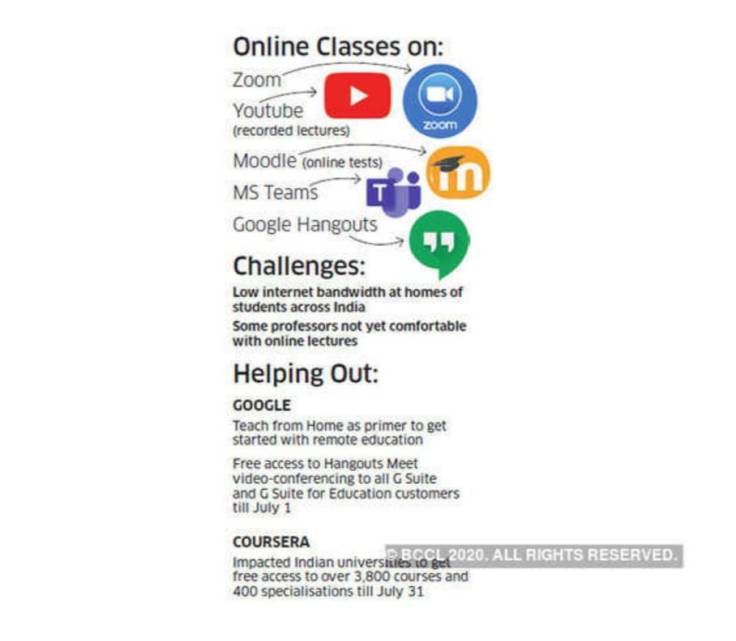
Covid-19 has not only forced universities across India but indeed the schools, colleges and universities in the entire world to suspend physical classrooms and have a radical shift to online education. This could have become a reason of a huge academic loss but the good thing is that almost every educational institution in India have indulged themselves in online education. This has been possible because of various tech software and online teaching sites like Go to meeting, Go to webinar, Zoom, Google hangouts and many more. It’s just so amazing that one is able to study during flexible hours and in the comfort of home. According to All India survey on higher education 37 million students in India are enrolled in higher studies. Online education is basically conducted in two ways, one being through the use of recorded classes, which, when opened out to public, are referred to as Massive Open Online Course (MOOCs) and the other being via live online classes conducted as webinars, or zoom sessions. Besides a balanced and stable IT infrastructure universities require high speed internet along with education delivery platforms. On the other hand students also need high speed internet, computers/mobiles to attend the classes or even watch/listen to pre recorded sessions. There are 993 universities and 39,931 colleges in India, but with the help of these online classes the studies are not being hampered. There are many platforms created that enhance the online education system in India. These are supported by The Ministry of Human Resource Development (MHRD), the National Council of Educational Research and Training (NCERT), and the department of technical education. More so there are some of the initiatives like e-PG Pathshala (e-content), SWAYAM (online courses enrolled by students or even teachers). the main aim of such courses is to increase connectivity with the educational institutions and to have more access to the content. These are utilized for course materials and classes, and running online modules. The Indian Institute of Technology too has started online classes. The National Programme on Technology Enhanced Learning (NPTEL), a project initiated by MHRD is initiated by seven Indian Institutes of Technology (IIT), was created in 2003 to provide online education. The aim was to have web and video courses in engineering, sciences, and management. Softwares are even providing free access of video conferencing for studies till July 1 amid these times. Online education in the form of webinars or online classes held at various software are so interactive, students can ask any question through chat or even by unmuting the mic and directly talking to the teacher. Other benefits include that the teachers can and are using approaches like designs, quizzes and smaller interactive sessions which would not overlook the discussions and debates that were more relevant in physical classrooms.

The best educational institutions like IIT Delhi , JNU , JMI and others have shifted to online teaching procedure. Like every other thing online education too has a drawback but according to me it’s very little as compared to its advantages. The main drawback of online teaching is of technical issues and internet speed. The main problem comes when students face network problems as even the consumption of internet is increased because all the family members are working from home. Also there is no denial to the fact that while technology is enabling, it can also be limiting, especially in India, where basic access is a challenge. Not every student has a computer or fast-streaming internet at home. This leads to issues with attendance and participation in online sessions. A survey by IIT Kanpur revealed that 9.3 percent of its 2789 students were not able to download material sent by the institute for online study. Another survey conducted by Local Circles among 25,000 respondents found that only 57 per cent students had the required hardware — computer, router, and printer — at home to attend online classes. It’s obvious that these facts cant be overlooked but amid these times the education can’t be curtailed to students and Overall the usage of digital platform by schools, universities and colleges has reduced the academic loss to a great extent. UNESCO estimated that lockdown has impacted over 32 crore students in India. Previously, online education was mainly for working professionals & distance learning students who used it as a learning tool because of the convenience, flexibility and affordability but Today, because of the onset of COVID-19, this scenario has completely changed. The tables have been changed and Online education with its adaptability to a widespread target audience ranging from KG kids to college students have reached a wider target group and has gained a lot of popularity. For example Byju’s which is one of the country’s leading online education platform has seen a spike in users during lockdown. In just initial two months of lockdown it recorded over 13.5 million new students who are learning online. This shows that while schools are already shut and other learning sources being uavailable, online education has seen a sharp rise. Divya Gokulnath who is the cofounder of the app said in an interview that the learning app recently ranked among the top 10 most downloaded apps on google play store and it also features on UNESCO’S curated list of credible educational applications as well as CBSE’s list of online mediums for students to continue learning during these uncertain times.the higher education sector in Kerela will face major changes in post covid Kerela. The higher education council has declared that the online classes mode will continue simultaneously with classroom education. Having surveyed over 2000 students in India, Brainly found that while 63 per cent of the students have an off from school, only 36 per cent of them are receiving online education while at home as of 17th March. Speaking on the survey, Michał Borkowski, Co-founder, and CEO, Brainly, said, “While numerous schools in the country have tied up with ed-tech platforms to offer online learning to students, our survey findings indicate that a major chunk of them have not made such associations yet. We expect more schools and teachers to follow this path however and introduce online learning in the upcoming days. This is what we are already observing in other countries. Students and parents seeking assistance for their academic queries are turning to online learning platforms, such as Brainly, where they can get help with learning already.”
The other example of online education includes Enguru, an app that helps users improve their spoken English in their native language, which is meant for IELTS aspirants. With the newly launched IELTS courses, Enguru aims to expand the users’ horizon by offering them more options all integrated into one app. The introductory class is free for all users and it explains the course structure, duration, the content covered throughout the course and prerequisite skills that are required to gain a better understanding of the course. Enguru has over 30 million users across Android and Jio phones. Some key features of the app include learning English from 27 Indian and foreign languages, gamified and adaptive modules across various difficulty levels, stimulated conversations to practice speaking and video lessons. E-learning has made certain that curriculums have kept their timelines, and additionally emerged as a great asset to education. Research shows that developing countries like India and China are significant players boosting the demand of online education market.while Europe, north America and middle east and Africa are already continuously witnessing the demand of online education system. The Online Education market is developing and expanding at a significant pace. The Online Education market is mainly driven owing to growth in acceptance of distance learning courses and constant enhancements in the technological advancement arena in both developed & developing countries. Apart from these the factors like adoption of smartphones, along with the wide availability of internet and off course with the help of initiatives taken by government enhance the growth of online education. However, lack of knowledge about online education in some of the regions, and nonavailability of free courses on the internet are reasons to hamper the growth of learning online. According to research Asia Pacific region is contributing towards the growth of global Online Education Market and is anticipated to exhibit higher growth rate over the forecast period of 2018-2025. However We are lucky that we have the opportunity to study during the times of pandemic so we should make the maximum use of it and enhance our skills and knowledge..!
No matter what but the show must go on !
BY AMITOJ KAUR
 Street Paradise
Leave a comment