

We all have already heard a word ‘online education’ – a type of education in which a student learns via internet just by staying at home. He or she uses internet to improve their skills. But when ‘online education’ came to our mind we immediately thinks of an intelligent child uses internet to learn extra from the schools or colleges. We immediately thinks of an extra ordinary, intelligent child. But who knew ‘online education’ will be on the minds of each person where they are students, teachers, parents or anyone else in the world in 2020.
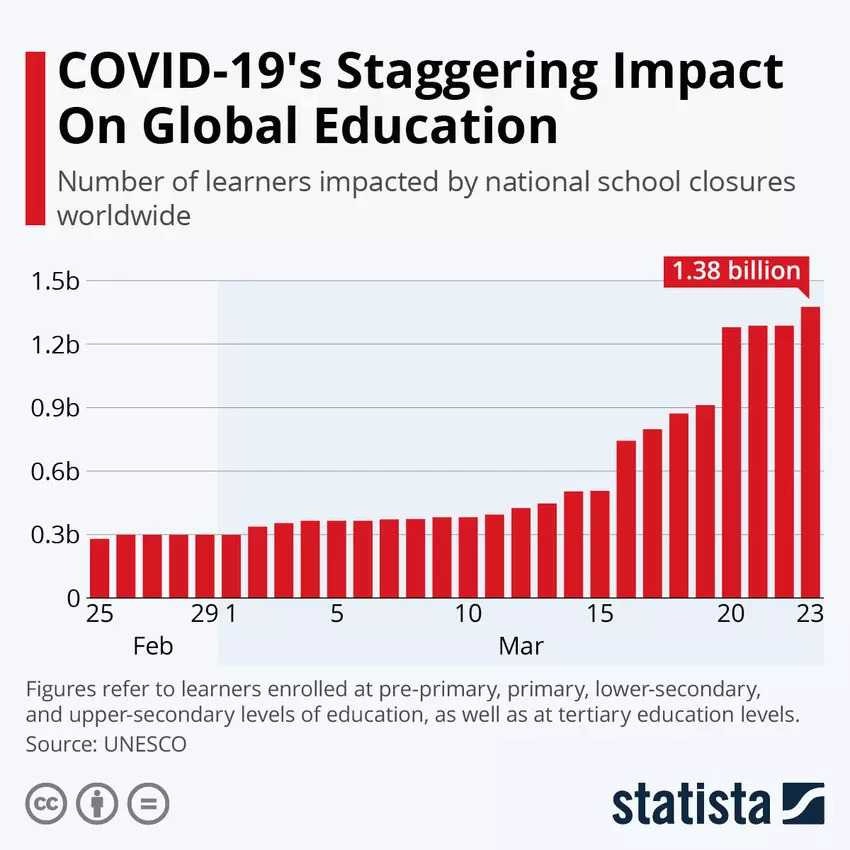
In the current situation of COVID-19 pandemic, where the world has been shut down and so the schools and colleges. Globally around 1.2 billion children are out of the classroom. And as a result, education system has changed. From studying in schools and colleges, students are now learning through internet via digital platforms just by staying at their homes. The research suggests that e-learning has been shown to increase retention of information, and it take less time, meaning the changes COVID-19 have caused might be here to stay.
Even before COVID-19, there was already high growth in online education technology, with global edtech investments reaching about $18 billion in 2016 and the overall market for online education projected to reach $350 350 billion by 2025. Whether it is language apps, virtual tutors or video conferencing apps, there has been a significant growth in usage since COVID-19.
BYJU’s has seen a 200% increase in the number of new students using its product, according to Mrinal Mohit, the company’s Chief Operating Officer. Zoom, a video conferencing app became the most used app.
By February 2020, Zoom had gained 2.22 million users in 2020. On one day in March 2020, the Zoom app was downloaded 2.13 million times. Daily average users rose from about 10 million in December 2019 to about 200 million in March 2020, with 300 million daily meeting participants by the end of April 2020.
India is going to witness a 50% increase in students over the next 15 years and although it has many universities and colleges, only few have the facilities to match this surge of students in the future. Online education could be a logical solution to accommodate this problem.
Digital Divide
Only 36 percent of the Indian population, about 385 million above the age of 12, has access to the internet, according to the India Internet 2019 report by IAMAI and Nielsen. However, the access is not uniform with just 27 percent in rural areas and 51 percent in urban areas getting access to the internet. WhatsApp has over 400 million subscribers in India, the majority in urban parts of the country.
gap is seen across countries and between income brackets within countries. For example, whilst 95% of students in Switzerland, Norway, and Austria have a computer to use for their schoolwork, only 34% in Indonesia do, according to OECD data.
CONCLUSION:
As in this pandemic, students are continuing their educations via internet while there are some students who don’t have access to internet and they are suffering a lot. technology should reach to every part of the world. only then the online education will be considered was a future of education.
BY: GARIMA
 Street Paradise
Leave a comment